Thursday, April 28, 2011

Re-set Day #2

This was day two of my "re-set," before which I went 36 days without doing a gym workout. During this "drought," I continued to swim and bike, but not at a normal frequency. Things at work and at home have just been two busy. So, I'm trying to start again.

My schedule today was a little different than planned, so I did not have time to swim at midday when my pool is open. I also did not have time to do much gym workout, but I did get in about half of what I planned. I did two sets of bench presses using 105-pound weights. My first set was 13 reps and my second set was 7 reps. I felt a lot stronger today compared to yesterday, so my muscles seem to have recovered well from that 2,050 yard swim on Day #1. I have a lot of delayed-onset muscle soreness (DOMS) in the midline fibers of my pectoralis; I believe these are sore from doing the bench presses yesterday rather than the swimming. So, it seems that my bench press form was not as bad as I thought; I really was working the pectoralis (I feared I was doing the exercise wrong, relying too much on muscles in the back). My infraspinatus muscle is not painful today.

Is it strange to enjoy DOMS? It's a feel-good sort of pain, and I get some pleasure out of massaging myself in the area of soreness. Hey now...get your mind out of the gutter. I'm not talking about that kind of massage!

Today I also did about 40 reps of a rotator cuff exercise, and then my girlfriend arrived and I had to quit.

I now feel like I've been cheated out of the parts of the workout I didn't have time to do today, so I've got a new plan for tomorrow in order to catch up. Tomorrow I will wake up early and take advantage of the pool hours in the morning. Then at the end of the day I'll go for a 20-min run followed by a gym workout consisting of bench press, rotator cuff elastic band exercise, and pull-ups.

Wednesday, April 27, 2011

Re-set Day #1

Yesterday I posted an entry that discussed how I have skipped the non-cardio portion parts of my workouts for the last 36 days. I set some goals for the first few days in order to get back into a routine. Today is Day #1 of that plan. Here is what I did:

At swim practice this morning I swam 2,050 yards. This exceeded my goal by a considerable degree, but what I do in practice is dictated by my coach, so I was simply guessing at what he'd have me do. He worked me hard today! I started with 500 yards of warm-up (I only did freestyle today). Then 6x50s of a finger-drag drill, which is meant to help me put my hands in the right place as they start their catch. Then the coach taught me a new drill in which I swim 50 yards but interrupt it twice to do a 360-degree somersault. This helped me improve my flip-turn, since my flip turns have gotten really sloppy lately. Coach reminded me to pull my hands all the way into my chest at the start of the flip; this speeds up the flip and helps me initiate it better. I was also told not to breathe right before doing a flip because that lifts my head out of the water, which makes my hips sink. Lastly, on the flip-turn, I should not be afraid to hit the wall when on my back; I can turn over after touching the wall. Otherwise I waste time flipping and then kicking. Most of the rest of swim practice was 3x200s on 4:00 and 4x100s on 1:45, which means the faster I go, the longer I can rest in between. This seemed to work well for the 200s, but I got zero rest between the 100s because it took me 1:45 to do each 100 yard swims. 

But enough about swimming. My goal this week is to increase my weight-lifting activity. So this afternoon I came home from work a few minutes early and did some bench presses. I started at 105 pounds as planned, but I was unable to do 15 reps like I expected.  The [excessive] swimming earlier in the day has killed all the strength in my left shoulder area. In particular, my left infraspinatus muscle is sore. I don't think I've done any great harm, but it is clearly in the midst of repair and I have no strength there. Hmmm, consulting Delavier (2006), I don't see the infraspinatus included in the list of muscles used during a bench press. So maybe some other muscles in my left shoulder were affected by my swim today. Either that or (1) I'm engaging the wrong muscles to do the bench press, or (2) I'm simply weak from lack of lifting exercises during the last 36 days. I don't think it's (2) because my left arm was definitely weaker than my right as I attempted to lift the barbell.

I did some rotator cuff exercises, too. I did most of what I planned, except that I was unable to do 20 reps of two types of elastic band exercise that involves exerternal rotation of the left shoulder. I only did 10 reps of those exercises, as my arm felt weak and I didin't want to do harm. Consulting a few websites confirms that it is the infraspinatus and the teres minor that are responsible for external rotation.

Finally, I did 1.5 pull-ups. My goal was 2, but I was unable to get all the way up on the second one. I know a lot of my "inability" to accomplish my goals is all in my head. I am afraid of hurting myself, and that isn't exactly a bad thing, but it also keeps me from moving forward and getting stronger.

I am exciting for tomorrow's workouts and I'll report back on my results later.

Tuesday, April 26, 2011

Breaking the weight-lifting drought

I've completely let go of weight lifting for about a month...36 days to be exact. It all started with a 4-day conference and the preparations leading up to it. Upon my return, there were other engagements at work and a few weekends spent with friends.  So those are my excuses. So what am I going to do about it?!
I need to start back up with a slow transition from nothing to something. I propose this for two reasons: (1) I don't want to hurt myself, and (2) I don't want to set a goal/make promises I can't keep. So here is my schedule for the next two weeks:
Wed 27th: Swim practice as usual (1300 yards). When can I do some lifting? I teach an evening class. I will endeavor to come home from 5pm to 6pm before my 6:30pm class. I will do 115-pound bench press reps to exhaustion or up to 15 which ever comes first. Based on how that goes, I will add weight and do another set with fewer reps. Well, hmm, that doesn't sound like starting slow. So let's start with 105 pounds instead. I will also do rotator cuff exercises because I need to do those to keep my shoulders in shape. Finally, I'll do 2 pull-ups.
Thurs 28th: I'll swim again in the afternoon (1100 yards). Then I'll come home around 5pm and repeat the exercises I did the day before (even if sore).
Fri 29th: I teach through 4pm and then I'll probably head over to a friend's house. There won't be much time for weightlifting or swimming, so let me squeeze an outdoor run into my lunch break. I'll leave around 12:45 and come back 20 min later. Don't forget the hear rate monitor and the MP3 player! I'll grab lunch after my run and then teach class at 2pm.
Sat 30th: Probably no swimming, and I'll be sore from the run the day before. But let's fit in some weightlifting (add upright row to the list). 
Biceps on 2/24/11. I won't stay this strong if I fail to workout regularly!
Sun May 1st:  Church in the morning, but I'll have time to do a bike ride in the afternoon. I'll also do a lifting workout: bench press, rotator cuff, pullup, bicep curls, lateral raise, and abdominal crunches...the whole list (I used to do this sort of thing every day).
Rest of May:  Responsibilities at work lighten considerably, so I will do cardio every day and lift weights to some degree four days a week. I have to get in shape for my first triathlon in mid June!
I know that tonight I can write any plans I want, but it won't do me any good if I don't commit. So I will update this blog each day through the end of the month, reporting on what I did or didn't do. My readership is small, but the point with the daily updates is just to keep me energized and ensure I follow through.

Saturday, April 16, 2011

18 miles of biking and whitewater rafting

On Sunday I accompanied a few students of mine on a bike/paddle trip. The trip wasn't my idea, but when they proposed it, I was very happy. I knew it would be fun, and it was. I met what I thought would be a group of 15 college students on my campus at 8am on Sunday morning. We were due at the river outfitter's shop around 9am. The trip organizer and her boyfriend joined me on campus at 8am, but no one else showed up. College students always find ways of disappointing me, so this wasn't a huge shock, and I didn't let it bother me much at all that day. We arrived at the shop around 9:20am and the staff were surprised that we were a group of 3 rather than 16. I shrugged and said, "well, it's too early in the morning, it's cold, and they are college students." Indeed, most students didn't have any better excuse than "I stayed up too late last night, so I didn't feel like getting up." Before I get too flustered about the maturity level of people who insist that they should be treated like grown-ups (they will quickly grow up, but only after being coddled in college), I better get to talking about the good and fun things about our trip.

We were fitted for the bicycles we would rent. Our route was a steady, 9-mile incline along a river upon a dirt trail that used to be a railroad bed. It was a pleasant and easy ride, and we completed it in a little less than an hour. MapMyRun tells me that I climbed 240 feet in 8.67 miles.

Arriving at a parking area, we met a Guide with a pickup truck. He gave us our raft and loaded our bikes onto the truck. He gave us wetsuits to put on in a nearby rest room. I had never worn a wetsuit, but it went on easily and felt comfortable, so I'd do it again. The Guide also provided a packed lunch for us. It was only 11am but I was strangely hungry after the bike ride. Instead of leaving the three of us to eat lunch by ourselves, the company guide sat with us. This was awkward. I felt I needed to engage him in conversation, so I asked a few questions. He talked about hunting rattlesnakes in the area. "Hmmm, interesting," I said. "Is that just a hobby? What do you do with them?"

"I eat them!" he enthusiastically replied, not understanding that consuming rattlesnakes for food is a rather unusual thing to do. As we finished up lunch, the Guide began giving us instructions on paddling down the river. He suggested that at such-and-such falls, we should keep to the left, but at another set of rapids, it would be best to keep right. None of these instructions were helpful, because we had never been on this river before, and we didn't have a map that told us the names of each set of rapids. I was getting nervous, but this was unnecessary. For the most part, the "rapids" and "falls" were harmless, and I think the greater danger was running aground in shallow water, and not capsizing the raft. One exception to this was the last set of falls. The man told us that we would encounter a giant rock in the middle of the river. It would be a more gentle passage if we went right of the rock, but then we would very quickly have to cut across the river to the left in order to land at the boat launch. Otherwise, we would miss the exit point and be at risk for going over a large waterfall about 200 yards downstream. So, to avoid those potential problems, the man suggested we go left at the giant rock. He said this course "would be more fun," and we could then easily exit the river.

It took about 2 hours to raft down to the giant rock the man told us about. Early on, we decided to go left to avoid the problem of missing the boat launch and going over a nasty waterfall. I was in the stern of the raft, so I was in charge of steering. It amazed me how slight a change in paddle orientation would affect the raft's direction. I also appreciated the strength required to steer; I may not have burned much energy paddling, but my abdominal muscles and back muscles were sore the next day. Steering, I took us left of the giant rock. But then there were smaller rocks ahead of us, forming a ledge and a 3-foot waterfall. We were headed for one of these rocks and I couldn't decide whether to go to the right or left. The river took us right into the rock. "No big deal," I thought, "the water will make the decision for us, and push the raft to the right or left." But the water didn't make that decision. We got hung up on that rock; the front third of the raft was grounded on the rock and we didn't go anywhere for a moment. In our efforts to dislodge ourselves from the rock, the raft began to turn. The water pushed the rear of the raft unto another rock so that now our raft was perpendicular to the flow of the water. We were stuck again, in a precarious position! Rushing water on our left, and a steep drop to our right. The student sitting at the front-right corner of the raft looked over her side and saw the steep drop. She panicked and threw herself to the left of the raft, grabbing the student sitting in the front left corner. This changed the distribution of weight and the raft began to turn. I ducked low. The rushing water then turned our raft parallel to the river again, but this time the stern was in front and the bow in back. We went down the 3-foot waterfall backwards!

I loved it. There were so many possible outcomes to this story, and I never would have guessed that we would navigate a waterfall going backwards. With no skill whatsoever, we somehow avoided capsizing, falling into the river, hitting our heads on rocks, and getting hypothermia. I laughed in hysteria for the rest of the ride to the boat launch. The students were a little in shock, but my good attitude helped them recover fairly quickly.

Saturday, April 2, 2011

Research results I learned from a conference

I attended a conference this weekend and had a blast. It is always great fun to see what others in my field are doing. I am a biologist. Biology is a broad field, and while I am an expert in one or two areas of biology, I have a lot to learn in other areas. I suppose that is true of anyone, regardless of their type of training. So below is a list of a few random things I learned (or re-learned), which I thought my readers would find interesting:

1. Levels of both testosterone and insulin-like growth factor (IGF) increase in the blood after cardiovascular exercise. The researchers tested blood before and after a 20-40 min session on a stationary bicycle, at different levels of exertion, and found that both hormones increase during the hour following exercise. The researchers did not follow the participants after 1 hour, so I don't know how long the effect lasts. Levels of IGF increased greater following 40 min of exercise compared to just 20 minutes of exercise, and IGF was also higher after intense exercise (at 90% maximum heart rate) compared to more moderate exercise (75% maximum heart rate). These findings are significant, because both T and IGF function to facilitate muscle growth and repair. I knew this before, but this work reminds me that it is not a direct link between exercise and muscle growth; certain hormones and their cellular receptors must be in place and operate efficiently in order for my efforts to pay off in stronger or larger muscles.

2. Exercise moderates the effects of psychogical stress on a person. We all know that exercise makes us feel good, and this research showed that people who had recently exercised (within a couple hours) were better able to cope with a psychological stressor (graphically disturbing images) than people who had not exercised before exposure to the stressor. The investigators used functional MRI technology to measure brain wave patterns while people viewed disturbing images (violence and injured people). Those who had exercised prior to the fMRI had less brain activity in parts of the brain involved with coping with stress. I am pleased to know about this finding and will plan to use exercise both as an outlet for getting rid of stress, as well as a preventative medicine for combating stressors I might encounter after a workout.

3. An injury to the anterior cruciate ligament (ACL) in the knee may not always need surgical repair. A researcher presented a case study in which physical therapy was utilized for two months following injury with the objective of strengthening the hamstring and quadriceps muscle groups (actually, I can't remember what other muscle group was chosen besides hamstring). With stronger muscles, the knee joint was stabilized and the patient (a college football player) could go back to playing in games. The researcher does note that the knee stability is dependent on these muscles remaining strong. If the patient stops exercising and the leg muscles atrophy a little, the knee will go back to being unstable and may require surgery in the future. I have never had any serious knee issues, but I expect the same principle would apply to other joints. For example, I struggle with a chronic shoulder injury, and I find that weekly rotator cuff exercises keep the joint strong. If I stop the exercises for a string of days, the shoulder feels weaker and I am prone to straining it.

4. Some cases of obesity is due to mindless eating. Dr. Brian Wansink of Cornell University was a keynote speaker at the conference (see http://mindlesseating.org/index.php). He presented his research that showed that the amount of food people consume at meals is dependent on the size of their plate. He also presented work that showed that the good taste of food (which is why +30% of people say they over-eat) is not as much a function of flavor as it is expectation. If you go to a fancy restaurant, you expect the food to taste better, even if in reality it is the same food served at a less-fancy restaurant. Dr. Wansink showed that people ate a greater portion size of "Belgian Black Forest Chocolate Cake" compared to "Chocolate Cake" when the actual cake was the same but the name it was given on a menu differed. He noted with some humor that the Black Forest isn't even located in Belgium...it is in Germany! This research is fascinating and will hopefully help me reduce my caloric intake on strings of days when I don't exercise (otherwise, I can't get enough calories).


Monday, March 28, 2011

Pull-up #3

My headline refers to the fact that today I did 3 pull-ups in a row and it felt pretty good. It is probably time to push myself to do 4 next time (good thing this is an anonymous blog, or else I would feel so embarrassed at the small number).

I am very cautious with pull-ups because I seem to pull a muscle every time I do them. I'm exaggerating, but still, I seldom do them because (1) I need to make sure I'm warmed up by doing other exercises, (2) I need to make sure I'm not too tired to do them properly, (3) if I'm at home, my doorway-mounted pull-up bar is too close to the floor so my form suffers, and (4) if I'm at the pool or fitness center, I don't want anyone to see how few I can actually do. Looking at this list, I'm pretty much screwed. First, the first two items are often contradictory. Because I don't want to pull a muscle, I don't start a workout with pull-ups. In fact, I often wait until the end of my workout to ensure I am warmed up. But by then, I am tired, and the danger of pulling a muscle increases because of that. So many days go by without push-ups because I am too afraid. I have previously discussed the frustration I have with my doorway-mounted pull-up bar at home. I still do push-ups at home, but I am leery. My best option for pull-ups is on the pool deck where I do my swimming workouts. But if there are too many people at the pool, I don't want to be a spectacle. All this adds up to the simple fact that I physically don't have the strength to do many pull-ups in a row. And of course, if I don't push myself to do more, I never will gain the strength I desire. So I'm stuck with making very, very slow progress over time...like doing two in a row for several months, and then adding a third. 

About the graph: I started doing pull-ups in December 2009, and each day I do pull-ups I do as many as I can in one set. I probably should do more than one set, but I never have. So what is plotted here is the maximum number of pull-ups I could do in a row during one of my workouts, separated by month (red line). Also plotted (blue bars) is the average number of pull-ups completed per day in each month. Most of these averages are below 1.0 pull-up because I do not workout every day, and on the days I actually do pull-ups, I do a small enough number that it averages out to less than one per day. Looking at the data, there really isn't any trend. I haven't improved any over the last year; nor have I regressed. The only patterns I see are drops in the number of pull-ups done in the months of February 2010, March 2010, July 2010, and January 2011, which all correspond to minor shoulder or upper back injuries caused by doing too many pull-ups (or doing them with poor form, or with fatigued muscles, or with muscles not properly warmed up). So you can see, I have every right to be cautious as I try to increase the number of repetitions...

Friday, March 25, 2011

Fashionable Cycling Clothes?

I went for a bike ride last week around my house. I did 6.1 miles in 26 minutes at an average speed of 14.1 mph. It was windy, and there are steep hills on my route. According to MapMyRun.com, the biggest hill is a 3.1% grade that continues for 0.82 miles. MapMyRun rates this as a category 5 hill--the mildest of their six categories. Well, even if it's not the biggest of hills, I still have a hard time climbing it. And that leads me to today's topic: clothing.

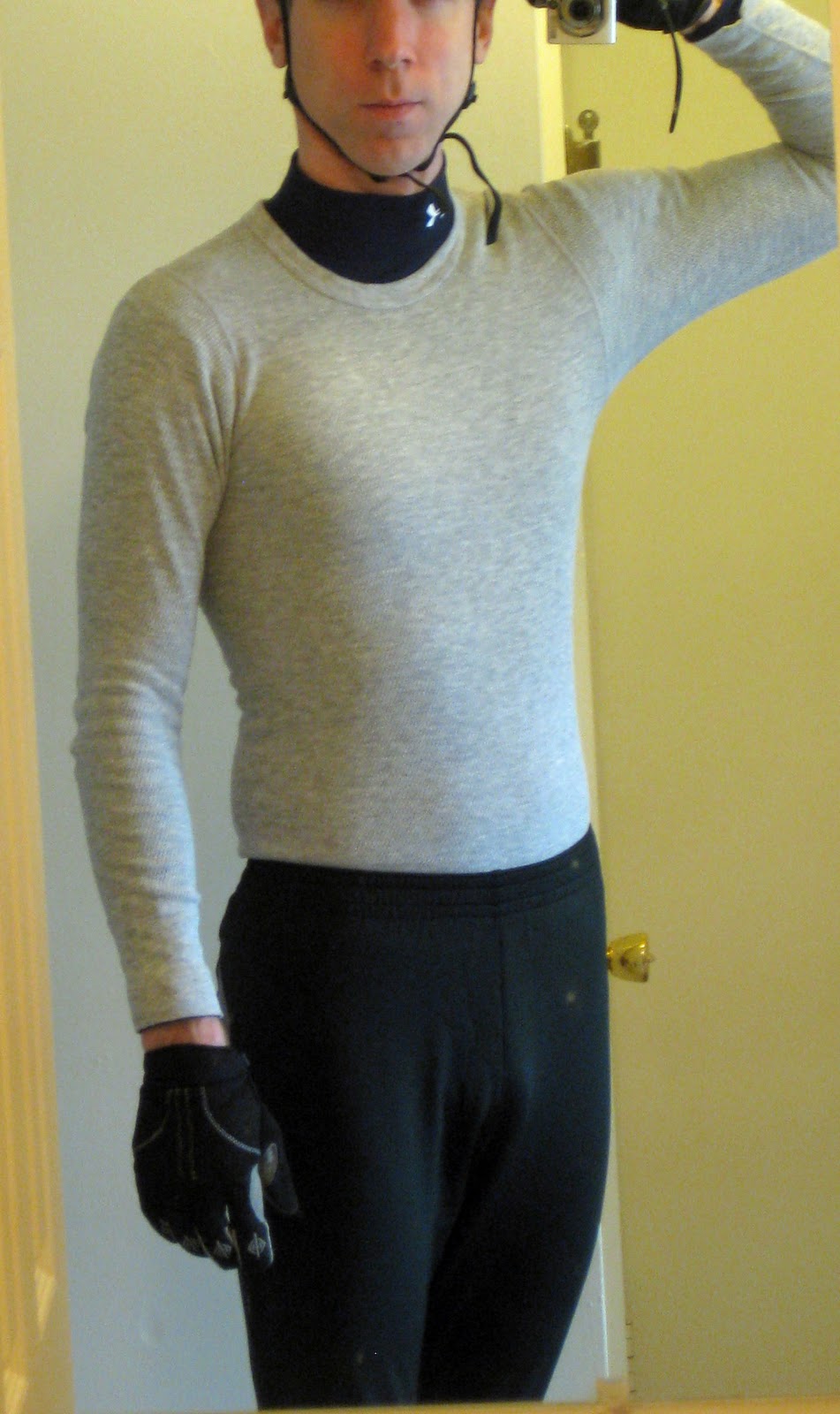
During my bike ride it was 54 degrees F with winds at 21mph gusting to 31mph (there is an airport weather station very close to my house). It's a little chilly for a summer-time outfit, so I wore the following: (1) old running shoes, (2) white cotton socks, (3) black UnderArmour tights, (4) compression shorts under the tights, (5) blue UnderArmour compression long-sleeved mock shirt, (6) gray long-sleeved cotton/polyester long-underwear on top of the compression shirt, (7) cycling gloves, and (8) a black and red helmet. My bicycle is white, if that matters.

How fashionable is this cycling outfit?

So what was my mistake?
Answer: For one, I had no fashion sense. The cotton/poly long-underwear over top of the compression mock shirt was the most blatant violation of fashion. After all, long-underwear is supposed to go underneath something else. A second potential mistake was wearing form-fitting clothing of any style. I have a great figure, so I'm not ashamed to show it off, but I also know that the UnderArmour is not really necessary when one is only moving 5 mph up some of the hills!

What statement does wearing a complete set of cycling clothes make about my cycling ability? I can easily envision myself wearing all the clothes of a weekend warrior cyclist--complete with cycling jersey and spandex shorts--with lots of miles under his saddle, but the reality is that I'm not that fast or experienced. What a funny sight it would be for me to wear the clothes of a professional but perform like an amateur.


Long-underwear and tights for cycling?

So I throw the question out to you, dear reader. What should I wear when I go cycling in chilly weather? Jeans seem to be too restrictive; sweat pants are too baggy and would rub against my bicycle chain. A shirt made of a thin layer of Lycra or polyester--the type of material that UnderArmour and cycling jerseys are made from--doesn't seem warm enough. At the same time, I'd look funny if I wore tights and a heavy sweatshirt. Suggestions, please!