Wednesday, February 23, 2011

Pyramid sets feel good.

Pyramid sets with the bench press will build the pectoralis fairly quickly. Probably.
Pyramid sets feel good. At least tonight when I did one. Or part of one. I routinely do two bench press sets of 15 reps at 105 pounds. This means I lift 105 pounds 15 times and then I rest for a couple minutes before repeating. I've been doing this over and over, month-in and month-out, and my pectoralis is no longer sore after these workouts (I do other weightlifting exercises, too). This means my pectoralis muscles are not being challenged, and they will not get stronger or bigger unless I work them harder. So, I changed things just a bit. I did my normal first set of 15 repetitions at 105 pounds. Then I went on to do a different exercise (1 set of dumbbell shrugs at 22.5 pounds). When I was done with the dumbbell shrugs I went back to my weight bench and did a set of bench presses using 110 pounds instead of 105 pounds. I am always afraid of hurting myself, so I never change things drastically from one day to the next. If I wanted to challenge myself a bit more, I would have continued to do a third set and then a fourth set of heavier and heavier weights. Each successive set would contain fewer repetitions until I got the point where I couldn't do more than 4 repetitions. I didn't do this tonight but maybe I will later this week. Even doing this one partial pyramid set, I could feel the additional effort being generated by my muscles to lift the extra 5 pounds and I'm pretty sure that tomorrow I'll be a little sore.

Pyramid sets seem to be a good strategy for building muscle mass fairly rapidly. This is because the pyramid sets purposely and progressively fatigue larger and larger motor units (groups of muscle cells that contract together) as a person lifts heavier and heavier weights. The large motor units are predominantly the fast-twitch fibers that can generate a lot of power but fatigue quickly. Fatigue could lead to one of two circumstances that promote muscle hypertrophy (growth in size). First, as one lifts heavier weights, microscopic tears may occur with in the muscle cells. The repair process adds protein myofilaments (actin and myosin) to the muscle, causing individual cells to expand and become stronger. Second, even if no microdamage occurred, the muscles that became fatigued did so because they temporarily ran out of stored glycogen (which can be converted to glucose and ATP to power the muscle contraction). Muscles will grow in size as the body replaces and augments the glycogen stores. 

I apologize for the technical stuff above, but I just gave a lecture on this to college students so it is fresh in my mind. My understanding is based on material found in the Exercise Physiology textbook I use, as well as in another book (at the office!) which I will reference later. I should also give credit to Davey Wavey for the pyramid set technique. Davey's fitness site is full of good material and worth browsing. I should note that Davey is gay and his appreciation for the male body is very apparent; however, even straight men like me will laugh at his sexual humor. And don't we all want better bodies? 

Sunday, February 20, 2011

Masters Swim Meet #3

Today I swam in my third Master's Swim Meet against YMCA teams from across my region. I'm new to competition so the times I am about to report won't be impressive to most of you, but I am still really pleased at my performance. Plus, I had fun....at least eventually.

The first event in which I swam was the 100-yard freestyle race. For purposes of review, at my last swim meet I swam the 200-yard freestyle race and became physically sick afterward from the exhaustion. I did not pace myself, so I burned through all my energy in the first 100 yards and had almost nothing left for the second half of the race. I finished in a little over 3 minutes. Based on this time, I conservatively submitted a seed time of 1:30 for today's 100-yard race. But earlier in the week my swim coach and I worked on pacing in preparation for today's event. He taught me to swim at 80% effort level for the first 37 yards or so, and then go all out at 100% effort for the remaining 64 yards. In training, I did this successfully and swam the 100 yards in 1:06 (1 min and 03 secs). I therefore had every expectation that I would beat my seed time. At today's competition I swam the 100-yard freestyle in 1:13. I was fatigued but not completely spent at the end. I also had a lousy flip-turn at the 75-yard mark. I am pretty sure that my strokes were too far out to the sides of my body, and I think I probably bent my neck too much while breathing. Good things about the race include the fact that at the 50-yard mark I was still leading my heat. My dive seemed reasonable, and unlike last time, my goggles did not fall off!

I had some Gatorade, a couple cookies, and did a "cool down" swim in the heated pool next to the lap pool, and I had plenty of time to rest before my next event.

My time for the 50-yard breaststroke event was 39.79 seconds. I had submitted a seed time of 39.0 seconds because the last time I swam this race competitively was in November 2010 at my first Master's Swim Meet and I had a time of 39.72 seconds. Thus, my performance today was nearly identical to what I swam before. I did not beat my heat--in fact, I think I was last--so this race didn't feel as good to me, despite the fact that I swam just as well as in November when I pulled a surprise victory against everyone in my heat.

My big coup d'etat was my third event, the 25-yard butterfly. I signed up for this without input from my coach. When I told him I was doing butterfly, he said "Wow, that's a big step." I replied, "Sure, but it's only 25-yards. What could go wrong in 25-yards?" My teammates were also surprised that I would attempt the butterfly. But ultimately, I swam very well! I finished in 16.90 seconds, faster than the 18.0 second seed time that I submitted (the latter being a simple guess based on the prior times of teammates with my similar level of skill and physical build). I also out-swam everyone in my heat with several body lengths to spare, and this made my spirit soar. The people I am competing against within my heat are not necessarily my peers in terms of age and gender. I still swam slower than a lot of people NOT in my heat, but I beat my skill-level peers. That felt good. My competitiveness is showing!

I am very happy tonight. I am swimming against people who have swam all their lives. In contrast, I never swam in school or college, and I didn't know how to swim until about 20 months ago. In fact, I wasn't taught the butterfly until fall 2010. Thank you, J.G., for teaching and coaching me so well.

Saturday, February 5, 2011

Lateral dumbbell raises

Two nights ago during my weight lifting I decided to bump up the weight employed during my bench presses. I've been pressing 100 pounds for the last month (usually two sets of 15 reps), and I felt it was time to add additional weight. But not too much weight of course, as I am always worried that I'll hurt myself. So, I added 5 pounds and lifted 105 pounds. It is surprising how much heavier that 5 pounds feels! I did 14 presses in the first set and 9 in the second. It won't take too long to get back to the two sets of 15 reps I usually do, and then maybe I'll add some more weight.

My workout included more than bench presses. I also did bicep curls (three sets of 15 @ 22.5 pounds), 2 pull ups, 51 abdominal crunches, and lateral dumbbell raises (two sets of 20 @ 10 pounds). This was a fairly mild workout because I felt tired and unmotivated, but that's another story. At least I did a workout!

Well, yesterday and today I've had a pain in my left posterior deltoid that persists despite a dose of Tylenol. I also had a pain on the front of my shoulder, either in the anterior deltoid or maybe one of the rotator cuff ligaments. I initially attributed the pain to a small injury I must have sustained as the result of increasing the bench press weight by 5 pounds. This would make sense except that the rotatory cuff pain has subsided and the pain in my posterior deltoid remains. The bench press--no matter how poorly executed--would not lead to an injury on the back of the shoulder. So the culprit must be the lateral dumbbell raises.

I use Delavier (2006) as a guide for doing lateral raises. Briefly, the exercise requires one to stand up straight with small dumbbells in both hands. Arms are straight at the sides and then lifted up until horizontal with the ground. Hands grip the dumbbells from the top so that palms are facing down.  Delavier says the exercise "should not be performed with heavy weights, but instead in sets of 10 to 25 reps, while varying the working angle without much recuperation time until you feel a burn." The reasoning behind using small weights is that if larger weights are used, you will recruit additional and larger muscles, and your smaller muscles (such as the supraspinatus) will not be pushed to their limits. He gives several other instructions that I used to follow but have since forgotten until now. For instance, the arms should alternate between positions slightly forward of the body and slightly behind the body so that all the muscle fibers of the deltoid are equally exercised. The deltoid muscle is a multipennate muscle, meaning it has fibers that run in different directions. If I simply lifted my arms at the same angle each time, I would exercise one part of the deltoid but not necessarily the other two segments. I have forgotten to do this with regularity, and perhaps that is why I am now a bit injured in the posterior deltoid.

The other reason might be the way I was holding the weights. You see, I used to lift 8-pound dumbbells. But then I increased it to 10 pounds. I do not actually own 10-pound dumbbells, so I have been lifting 10-pound plates instead. I have some plates that are solid (no hand grips!) and some that have spaces inside that allow me to grip them easily. I was lazy two nights ago, and instead of using the ones with hand grips, I elected to use the ones close by that had no hand-holds. The result was a very awkward feeling and a heavier lift, as I clutched the weights using my fingertips. This meant the weights were being held farther away from my central axis, which requires more work. The moral of my story is two-fold:
  1. Remember to maintain proper form when lifting, and review the instructions for each exercise regularly to ensure you haven't forgotten how to do it right.
  2. Don't be lazy. Use the proper equipment. 

Thursday, February 3, 2011

Nerve pain after treadmill run

On average, I go running about once or twice a month. At least, that's what I did in 2010 for a total of 48 miles (each run is 2-3 miles). Running is new to me though. In 2009, I only ran 4 miles! And before that, I never ran. Despite the running total of 48 miles in 2010, almost none of that occurred in the last four months of the year. For example, I recorded one 30-min run on Aug 28, 2010 and then nothing until Dec 23, 2010 when I ran on a treadmill. I was terribly sore after that treadmill run, such that it was hard getting in and out of a car. Sure, my leg and torso muscles were sore, but I had a more serious and "shooting" pain at the base of my spine that would radiate into the back of my thighs when I bent my waist or hips a certain way. And the pain was so severe on Dec 27, 2010, when I attempted to do another run on the treadmill that I stopped and walked very fast instead.

By January 5, 2010, I was well enough to again run on a treadmill and I ran for 32 minutes. I ran again on Jan 7th and 10th and one last time on Jan 31st. I was not sore in mid January, but I am sore again yesterday and today. The pain seems related to the sciatic nerves and I wonder why I'm feeling pain like that at age 36. I hope it will subside and improve as I increase the frequency of my runs. I figure the more I run, the more my spine and muscles will adjust to the forces related to each footfall. Our bodies are built to modify themselves in the face of new physical stresses, so come on body, do your work and let me run some more! 

Sunday, January 30, 2011

My first 1,650 swim

Yesterday my Masters Swim Team conducted the 1,650-yard freestyle mail-in Swim Meet. Usually we compete against other numerous other teams in the area, but we have a large organization and it takes a long time to swim a mile, so the 1,650 race is done at each team's home pool and the results are then sent into the central office for tallying. Teams have until March 7 to send in their results, so I won't find out how well I did in comparison to others in my gender's age group until after that date. No matter, though. I did not swim this event to compete with others. I swam it to see if I could do it. And I did. Until yesterday, I had never swam continuously for more than 800 yards, and I had never swam more than 1,400 yards in a single workout.

As you might have seen in my previous post, my goal was to swim 750 yards all at once, and then swim sets of 100 yards until I was done. This goal was based on the fact that during workouts on my own, I often rest for a minute at one end of the pool between sets of 50 or 100 yards of swimming.

I blew away my goal yesterday. I swam the 1,650 yards continuously and completely. I did this in 29 minutes and 30.04 seconds. This is not a fast time, but like I said before, this is a monumental feat for me anyway.

I can't say that the experience was enjoyable, but it wasn't miserable, either. I swam well and without fatigue for the first 675 yards. Then I started thinking "this swim is taking forever and I haven't even gotten to the halfway mark." After another 200 yards of mentally fortifying myself with phrases like "I know I can do this!", I started getting a cramp in my right foot. Getting a cramp in my foot or leg is fairly typical when I've reached the point of fatigue. It is usually triggered by an overly-enthusiastic flip-turn, and once I get a cramp, the pain and deformity might subside for a time, but the sensation remains and won't go away until after I leave the pool. So here I was, halfway through my mile swim, and I was getting a muscle cramp in my foot. For a few minutes I feared that I would have to cut my swim short. But then I simply concentrated on relaxing my leg muscles and swimming more with my arms and torso. I also stopped doing flip-turns and instead gently pushed off the wall at the end of each lap. In a way, the foot cramp was a helpful distraction, as I soon reached the 1,250 yard mark. My foot cramp had subsided by then, and I knew at that point that I would finish the race without stopping. My teammates on the pool deck cheered me on.

I was the last person in my heat to finish the race, but there were very few spectators, and no one seemed to be watching me as I did a flip turn and began to finish lap 33. To celebrate the end of my race and the success in doing more than I ever thought I could do, I swam the last 25-yards at top speed. As I said, no one noticed this little display of bravado, but it generated a great sense of accomplishment to know that I still had energy to sprint at the end of a endurance swim. Mile be damned! I could have swam farther.

Monday, January 24, 2011

Training for a mile swim

The title of this post seems a little grand, considering that I haven't actually been training that much for my upcoming mile swim. I've only gone swimming 5 times this month so far, for an average of 1,170 yards per workout. This compares to 10 pool workouts in December (average = 893 yards) and 8 in November (average=913 yards).

On Saturday I will gather with my YMCA Masters Swim Team to complete a mile swim, or 1,650 yards. Since it takes a long time to swim a mile, this is not a typical Meet where multiple teams will be represented. Instead, we will time each other and send in the results to the regional organization to be compiled and compared against the other competing teams' self-reported race times. So it is a race, but an informal one. I have never swum 1,650 yards all in one workout before. The closest I've come is 1,400 yards completed in a 60-minute workout (by myself) with plenty of rest between laps. I have also done 1,400 yards during a swim practice with my personal coach, but again, this was a 60-min session with rests between sets of exercises. What's another 250 yards? I know I can swim a mile, but the question is can I do it without stopping to rest? I regularly go 500 yards without rest and once I was able to go 650 yards without resting. At this point my heart rate is fairly low (140 beats per minutes) during these long sets, so I should be able to swim at a slow pace indefinitely, or at least for a time long enough to swim a mile. I think my body can do it, but do I have the will power to keep going after I pass the 650 mark?

The point of this blog is to establish goals publicly and come back and report on my results. This ultimately pushes me and makes me responsible for following through. So I will be brave and state here and now that on Saturday I plan to swim continuously for 750 yards. I will be feel free then to take a break at the end of the pool and start again after a minute or less on a set of 100 yards, and I'll keep doing sets of 100 until I get to 1,650. My race time doesn't matter because I have no record to beat (and I'm already the slowest swimmer in my age group!). I just want to finish.

Monday, January 17, 2011

Chronic injury of muscle in upper back

About 6 times a year I feel a popping sensation in my upper back (during weight-lifting exercises, when swiming, or even house chores) followed by pain and 2-3 days of disability. This chronic injury is very frustrating and I wish there was someway to strengthen the tissue to prevent it from tearing again. I assume the injury is a partially torn muscle, but I suppose it could also be a partially torn tendon instead. But let's go with the muscle possibility since that has a slightly better prognosis...

Below is the text that I wrote one day in November 2010 when I was recovering from my latest injury:

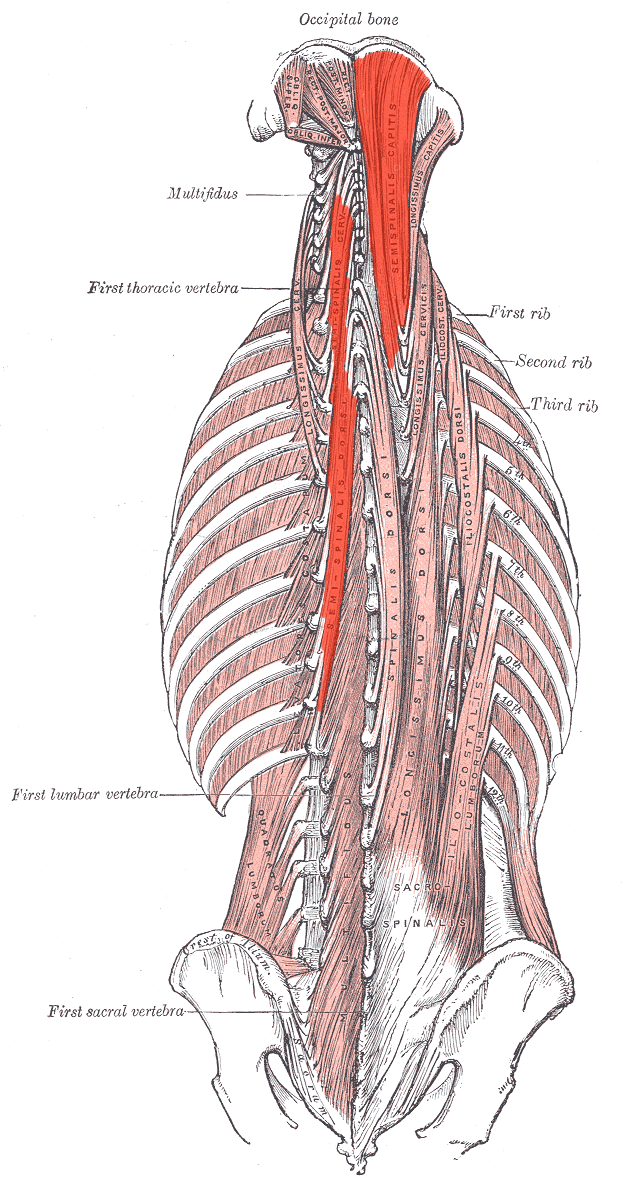
from http://en.academic.ru/pictures/enwiki/83/Semispinalis.png
I think I finally identified the muscle that I keep injuring in my upper back. But there are so many of them, I'm not sure. My latest suspect is the semispinalis muscle that lies either side along the spine underneath the trapezius and rhomboids. I surfed the internet looking for muscles that extend (straighten) the neck which are oriented paralel to the spine and which seem to be in the same location as my injury. There are several, but when I read that the semispinalis muscle also aids in extending the ribs, I felt a little more confident that I've diagnosed at least the site of my injury. You see, I sing bass in my church choir and sometimes when I injure my upper back and neck, I can't sing the low notes as strongly or loudly. This is a strange thing to link up with an injured back muscle, but if the semispinalis does indeed work upon the rib cage then it makes sense that an injury to that muscle would cause some disability in the finely-tuned actions of the ribcage muscles when forcing air out of the lungs during singing. I hope you see the link. I must admit that the website that I found this information on does not seem to be the most reputable. I don't see anything to make me doubt its veracity, but I have a weird feeling about the service that American Academy of Manual Medicine promotes. They also don't use punctuation well on their website!